Fleur-de-Lys de Gondelaurier
The Hunchback of Notre DameFleur-de-Lys de Gondelaurier is a noble heiress whose courtly aspirations and place in a wealthy household frame her encounter with Esmeralda and Phoebus de Châteaupers. In the balcony scene, a gentle attempt to draw Phoebus close becomes a painful recognition: the woman Fleur-de-Lys hopes to reconcile with him over is, in her eyes, a rival.
Identity and Household
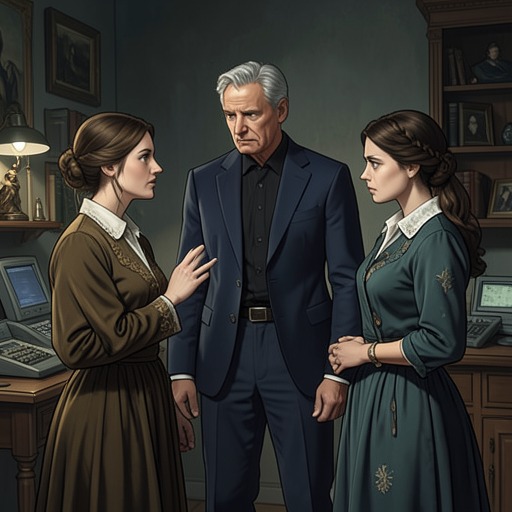
Fleur-de-Lys belongs to a circle of young women of good birth assembled at the house of her mother, Dame Aloise de Gondelaurier, a widow living with her only daughter at Place du Parvis, opposite Notre-Dame Cathedral. The young women include Diane de Christeuil, Amelotte de Montmichel, Colombe de Gaillefontaine, and the little de Champchevrier maiden. Their costly clothing marks their wealth and leisure: pearls twine through their pointed coifs, long veils fall to their heels, and embroidered chemisettes, fine petticoats, gauze, silk, and velvet make up their dress. The narrator singles out their white hands as another visible sign of their idle, privileged lives.
The household is also a setting for social ambition. Dame Aloise, formerly married to a commander of the king’s cross-bowmen, has received the young women while they await the arrival in Paris of Monseigneur de Beaujeu and his wife. The couple are expected to choose maids of honor for Margaret of Austria, who is to be received in Picardy from the Flemings. Squires from the surrounding region are already advancing their daughters for the favor, placing Fleur-de-Lys and her companions within a competition for courtly position.
The Balcony and Phoebus
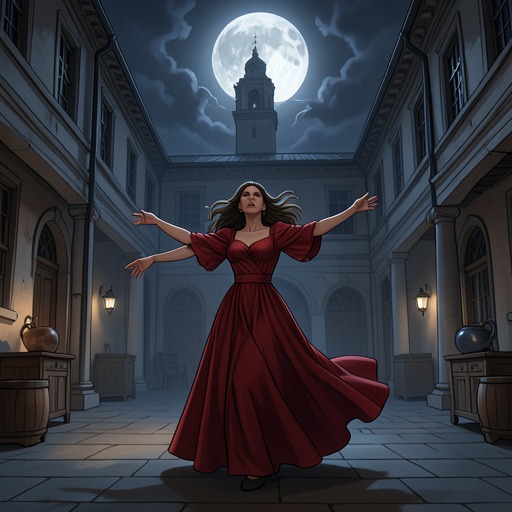
As Esmeralda dances in a circle on the square below, Fleur-de-Lys proposes that Phoebus de Châteaupers come closer to see whether he recognizes her. The invitation is gentle, and her careful use of his name signals a secret desire for reconciliation. She lays a hand tenderly on his arm and asks him to look at the dancing girl, whom she describes as possibly being the same gypsy girl. Phoebus approaches slowly and recognizes Esmeralda by her goat.
The encounter brings together the balcony’s private social world and the public spectacle in the square. Fleur-de-Lys is not merely watching the dance: she has made it the occasion for renewed closeness with Phoebus, while directing his attention toward the woman whose connection to him troubles her. The goat becomes the means by which Phoebus identifies Esmeralda, and the focus of the scene shifts from Fleur-de-Lys’s hopeful invitation to the recognition unfolding below.
Rivalry and Collapse
After the goat’s piece of folly, Esmeralda turns red, then pale, and trembles before Phoebus, who looks at her with satisfaction and amazement. The young women on the balcony are stunned when they recognize that Phoebus is the captain’s name Esmeralda has remembered. Fleur-de-Lys addresses Esmeralda as having a marvellous memory, but her astonishment gives way to anguish. She cries, “She is a magician!” and the more bitter thought within her names what the scene means to her: “She is a rival!”
Fleur-de-Lys hides her face in both hands and falls fainting. The physical collapse makes the shift from hopeful reconciliation to jealousy and distress visible, while her mother’s response turns the moment into an open confrontation: the terrified Dame Aloise cries, “My daughter! my daughter!” and orders Esmeralda to begone. Fleur-de-Lys’s role in the scene is thus defined by the reversal in her own invitation. She brings Phoebus toward her in the hope of repairing their relationship, but the sight of his attention and Esmeralda’s remembered name transforms the encounter into a recognition of rivalry.